

- What Makes a Fastener 'Industrial Grade'
- Eight Checks Before You Approve Any Batch
- Genuine vs Substandard: Quick Reference
- Why Anello Rises Above Others
- Five Questions Before You Confirm Any Order
- About Anello Fasteners
- Conclusion
- Get in Touch
A practical guide for engineers and sourcing teams
Nobody on a manufacturing floor thinks about fasteners until one fails. Then, suddenly, it's the only thing anyone's thinking about. A bolt backs out under vibration. A nut strips mid-torque. An anchor pulls free from concrete that was poured correctly. The fastener costs forty rupees. The downtime costs forty thousand. That math plays out more often than procurement reports tend to reflect.
The frustrating part? The bad batch looked fine. Substandard fasteners don't announce themselves — they sit in a tray next to certified ones and look identical. The difference is in the steel composition, the heat treatment, the thread tolerances, and the surface coating. Things you can't see. Things that matter enormously once the assembly is under load.
This is a practical guide to closing that gap — checking what actually matters before a batch is approved, not after it causes a problem on site.
What Makes a Fastener 'Industrial Grade'
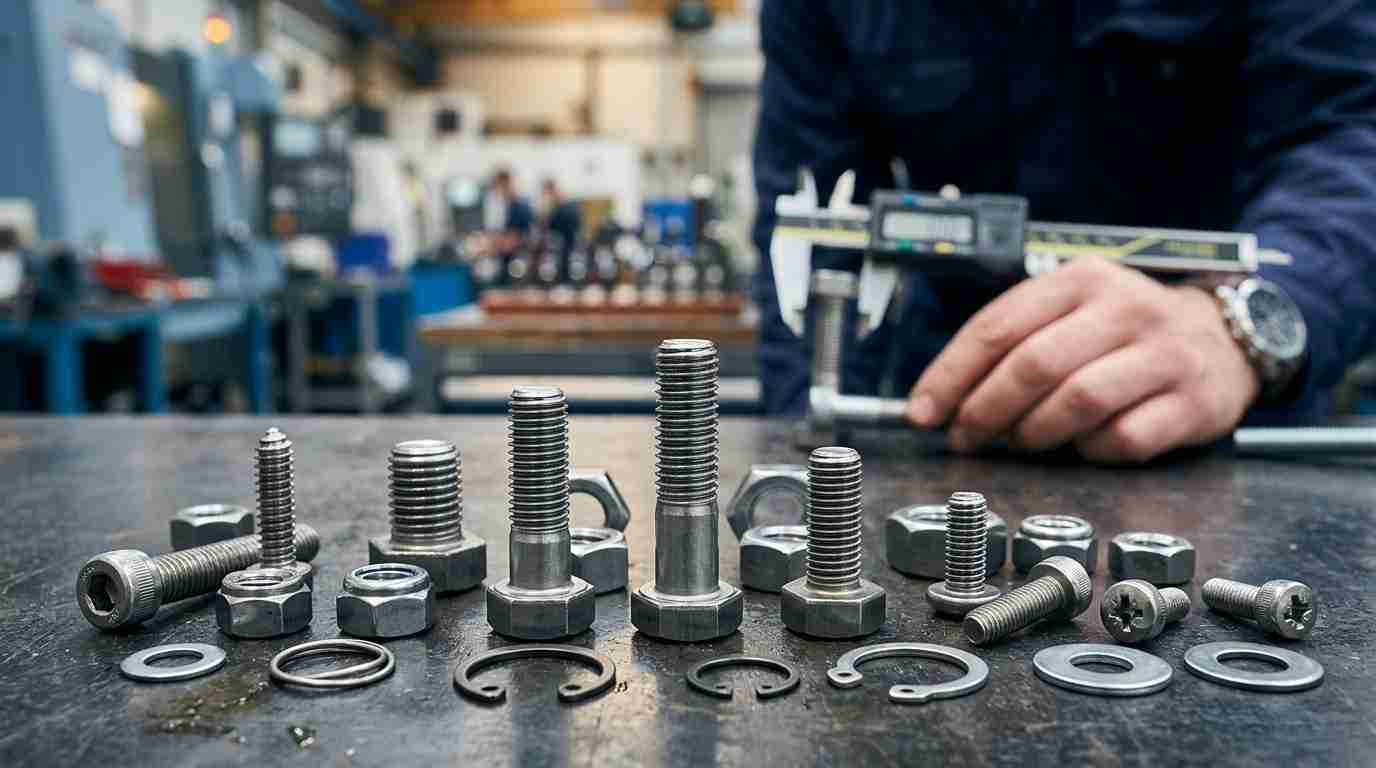
A fastener's job is to hold components in a fixed, load-bearing relationship — under tension, shear, vibration, sometimes corrosion, often all at once. That's a more demanding brief than it sounds. The range of types is wide: bolt fasteners for structural assemblies, nut fastener solutions for everything from machinery to railway fittings, screw fasteners for precision mechanical work, pin-type anchor fasteners for concrete and masonry, washers and circlips for load distribution and shaft retention.
What separates industrial-grade products from generic hardware isn't appearance. It's certified material, dimensional accuracy, and documented testing. Something that fits is not the same as something that holds. That distinction is where genuine fastener suppliers earn their reputation — and where substandard ones get found out.
Eight Checks Before You Approve Any Batch
-
Grade Marking
A genuine bolt or screw carries a clear grade stamp on the head — tensile class, material, manufacturer mark. Blank heads or blurred markings mean you genuinely don't know what grade you're working with. That's a traceability problem before anything else.
-
Mill Certificates
Every legitimate batch has a material test report traceable by heat number. No certificate means no accountability if something goes wrong downstream. Any fasteners manufacturer in India worth working with produces this without being chased for it.
-
Surface Finish
Run a finger along the thread and shank. Coating — zinc-plated, galvanised, plain — should be even throughout. Flaking, pitting, or patchy finish signals process failure. Not cosmetic. Structural.
-
Thread Fit
Hand-thread a nut onto a sample bolt. It should turn smoothly, seat cleanly, with no wobble and no binding. Off-spec pitch is something you feel immediately. Go/no-go gauges confirm it for precision work.
-
Load Data
Tensile strength and proof load values should be documented for every batch. If a supplier gets evasive when asked — 'I'll check,' indefinite delays — that's an answer in itself. Legitimate fastener suppliers don't hesitate here.
-
ISO 9001:2015 Certification
Ask for the actual certificate, currently, from an accredited body. Self-declared quality claims and outdated certificates are not the same thing as verified quality management. The difference matters more than most buyers realise until it doesn't.
-
Batch Traceability
Part numbers, batch codes, grade markings on packaging. Unmarked bags and mixed batches make after-the-fact investigation impossible. When something fails on site, you want to be able to trace it to the source.
-
Supplier Track Record
Years of operation and the industries actively supplied are harder to fake than samples. Decades of supply to automotive, aerospace, and railway clients represent trust earned through results. If you're searching for fasteners near me or evaluating a national supplier, this is the question that cuts through the noise fastest.
Genuine vs Substandard: Quick Reference
| Check Point | Genuine Fastener | Substandard Fastener |
|---|---|---|
| Grade Marking | Clear, readable head stamp | Blank, smudged, or absent |
| Material Cert | Mill cert, traceable heat no. | No documentation |
| Surface Finish | Even, consistent coating | Flaking, pitting, uneven |
| Thread Fit | Smooth, no wobble or binding | Off-pitch, loose or overtight |
| Load Rating | Documented tensile & proof load | Undocumented or unverifiable |
| Quality System | ISO 9001:2015, audited, current | No traceable certification |
Why Anello Rises Above Others
Apply that checklist to Anello Fasteners and it holds across every point. Head markings, mill certs, surface quality, thread accuracy, load data, ISO certification, full batch traceability. As one of the largest fasteners manufacturers in India, operating out of Rohtak, Haryana since 1968, the range covers hex and flange bolts, dome and hexagonal nuts, screw fasteners, anchor fasteners, washers, circlips, dowel pins, and CNC-machined components — all under one roof.
The operational side backs it up: ISO 9001:2015 certified processes, 50+ metric ton monthly capacity, in-house CNC and VMC machining, cold forging, heat treatment, and structured dispatch planning. As a leading fasteners supplier in India, Anello's network covers both local and national programmes, with active export capability alongside.
Automotive, railway, solar, defence, aerospace, switchgear, agriculture — over five decades across all of them. That kind of longevity is earned, not marketed.
Five Questions Before You Confirm Any Order
- Is the ISO 9001:2015 certificate current and from an accredited body?
- Can they produce batch-specific material test reports for this exact order?
- Does their capacity match your volume and lead-time requirements?
- Can they handle custom or non-standard specifications if needed?
- Which industries do they actively supply — and for how long?
About Anello Fasteners
Anello is a trusted name among contractors and procurement professionals seeking high-quality fasteners and best-engineered components. Anello Fasteners Pvt Ltd, since 1968, has been delivering precisely for more than 55 years. With a comprehensive product range and a commitment to consistency, Anello provides solutions that hold up under real-world conditions — literally and figuratively. If you are looking for fasteners, circlips, dowel pins, nuts, washers, bolts and other products, we are perfect for you. Anello also provides high-quality CNC-machined components and screws to meet the diverse demands of modern construction and manufacturing.
Conclusion
Fastener failures are rarely dramatic — they're quiet, gradual, and expensive by the time anyone notices. Grade stamps, mill certificates, thread accuracy, load data, a current ISO certification — five checks that take minutes and save thousands. A trustworthy fasteners manufacturer in India clears all of them without prompting.
Anello has been doing exactly that since 1968. Yes, the unit price occasionally looks higher than the alternatives. But factor in zero rework, no emergency replacements, and no site failures — the numbers tell a different story. Verified quality costs less. It just doesn't always look that way on the first quote.
Get in Touch
Looking for fasteners built to last? Contact Anello Fasteners for bolts, nuts, screw fasteners, anchor fasteners, and CNC components — made right since 1968.
Check the head stamp — it shows tensile class and material. No marking means no traceability. Always ask for the mill certificate to confirm.
Yes — from verified manufacturers. The largest fasteners manufacturers in India have supplied railways and defence for decades. Documentation and ISO certification separate reliable ones from the rest.
No. Bolt fasteners handle structural loads with a nut. Screw fasteners thread directly into material. Wrong application means joint failure — they're not interchangeable.
Concrete pull-out loads behave differently. Pin-type anchor fasteners are engineered specifically for masonry fixing. Regular bolts aren't — and "seems fine" eventually stops being fine.
Run the checklist — grade markings, mill certificates, ISO certification, and batch traceability. Price means nothing without documentation. Good fastener suppliers never hesitate on paperwork.
