

- The Problems That Show Up Again and Again
- What a Properly Built Bolt Kit Actually Contains
- How the Right Supply Chain Fixes Each of These Problems
- Features Worth Specifying — And Actually Asking About
- Where Heavy-Duty Bolt Sets Get Deployed
- Fastener Choice: Cheap vs. Engineered
- Why the Top Bolt Suppliers in India Are Worth Considering
- About Anello Fasteners
- Conclusion
I've spoken to enough site supervisors and procurement heads to know this pattern well. A project comes in over budget, corners get trimmed, and fastener specs get quietly downgraded. Nobody flags it. The structure goes up, everything looks fine for a while — and then one joint starts showing micro-movement, a flange starts weeping, or worse.
The bolt itself rarely gets blamed in the incident report. It's always an 'installation error' or 'design oversight.' But half the time, someone just bought the cheapest option without checking the grade documentation. Nobody asked for a mill certificate. Nobody verified the coating spec.
If your work touches heavy machinery, civil structures, or pressurised systems, the quality of your bolt sets isn't a minor procurement detail. It's a safety call. And chasing the lowest bolt prices without verifying what you're actually buying is a habit that tends to catch up with you — usually at the worst possible moment.
The Problems That Show Up Again and Again
These aren't unusual situations. They happen on ordinary projects, managed by experienced people:
- Someone orders a nut and bolt combination from two different suppliers to trim costs. The components arrive, the threads don't mesh properly, the crew loses half a day sorting it out.
- A coating that passed the warehouse check starts flaking within months. Pre-treatment was skipped somewhere in the plating process — nobody asked, nobody noticed until the rust showed up.
- A batch arrives with no documentation, no test report, no traceability. You call the reseller, they say they'll 'look into it.' Nobody can confirm which Bolt Manufacturing Company produced it, or whether it was tested to spec.
- Thread tolerance is slightly off from the mating nut. Not dangerously — just enough to require re-tapping on-site. Two days lost from a schedule that had none to spare.
- A non-standard length is backordered for five weeks. The distributor doesn't stock it, the manufacturer has a minimum run quantity. The project waits
Every one of these is preventable. None require exotic solutions. They require sourcing discipline and the right supply partner.
What a Properly Built Bolt Kit Actually Contains
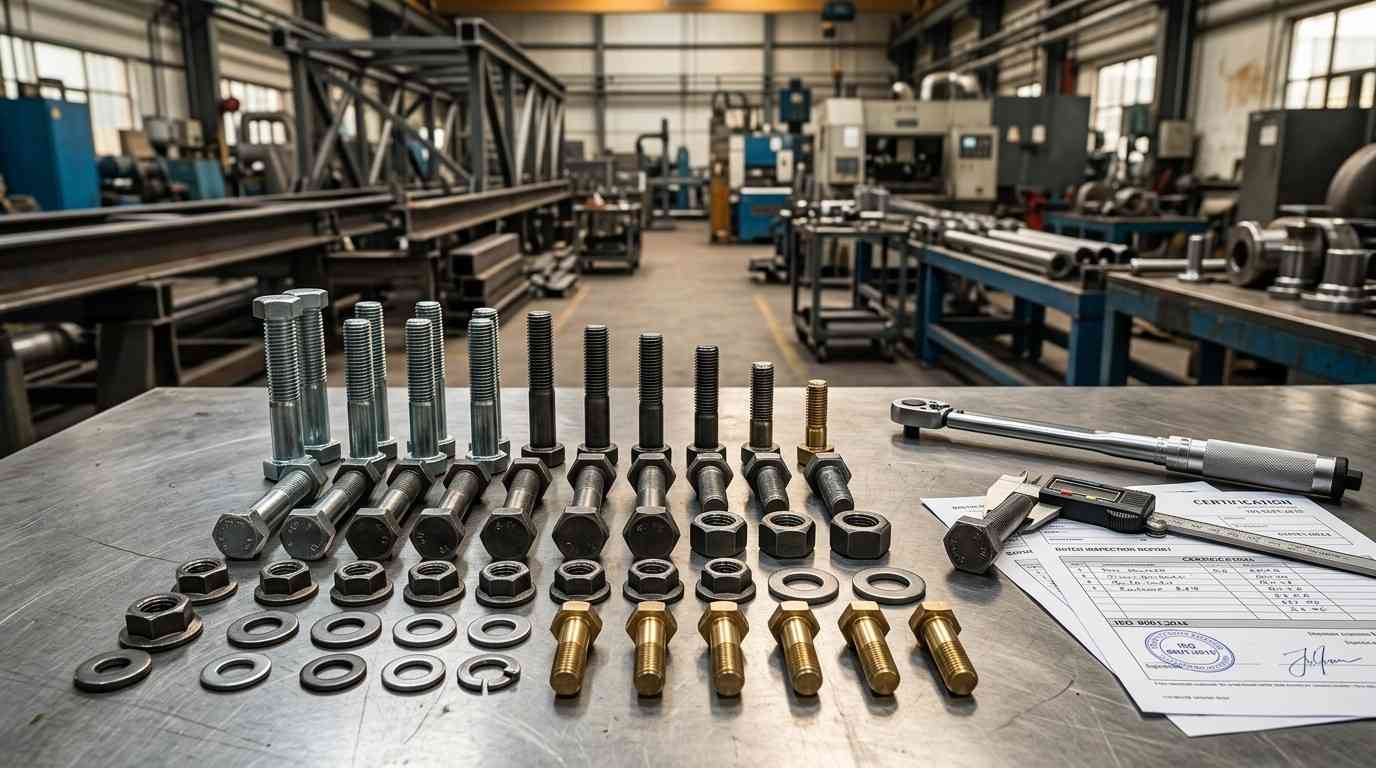
There's a version of a bolt kit that's just hardware in a bag — parts grabbed from three bins, called a set. And then there's the real thing: matched bolts, nuts, hardened washers, and locking elements drawn from the same production batch, same material certificate, same surface treatment spec.
Serious Bolt Manufacturers in India produce kits across grades 4.6, 8.8, 10.9, and 12.9. That range covers light structural connections at one end and high-tensile critical joints at the other — flanged pipe connections running at pressure and temperature, for instance.
For environments where carbon steel isn't suitable, brass bolts fill a specific role. Marine deck fittings. Electrical switchgear panels. Food-grade equipment. Chemical contact zones. In each of these, a brass fastener's corrosion resistance and non-magnetic properties are functional requirements, not preferences.
And on nut and bolt sets specifically — the matched-batch principle matters more than it seems. When bolt and nut come from the same run, thread engagement is exactly what the design assumed. When they don't, you're stacking tolerances in a way no careful torquing can fully compensate for.
How the Right Supply Chain Fixes Each of These Problems
The honest answer is most of these problems don't need better engineering. They need better procurement habits and better bolt suppliers. Here's what the difference looks like in practice:
- Mill certificates travel with every shipment — not available on request, just attached by default. Every batch, every time
- Surface treatment is documented to the environment: hot-dip galvanising for outdoor structural, zinc-nickel for automotive, passivation for stainless components
- Threads rolled after heat treatment — this is what gives high-tensile fasteners genuine fatigue resistance. Rolling before heat treatment is a shortcut that quietly costs fatigue life
- Reputable Bolt Distributors in India maintain batch-level traceability: heat number, test report, dispatch date — on record, retrievable, not reconstructed after the fact
- Regionally stocked common configurations ship within 24 to 48 hours. You shouldn't be waiting weeks for a grade 8.8 hex bolt in a standard pitch
Features Worth Specifying — And Actually Asking About
This is where the conversation with a supplier gets useful. Not 'do you have hex bolts' but specific questions:
- Cold-forged or machined heads? Cold-forged means better grain alignment, better fatigue life under load reversal. It matters in dynamic applications
- Thread class 6g/6H? This is the standard tolerance for interchangeable structural assemblies. Anything looser and joint behaviour becomes unpredictable
- Are the bolt kit components batch-matched? Nuts and washers from the same run as the bolts — not assembled from whatever's available in the warehouse that day
- Can you supply brass bolts with documented alloy certification? CZ360 or CZ385 with actual composition testing — not just 'it's brass'
- What is the coating thickness in microns, with a certificate? Per ISO 1461 for hot-dip or equivalent. A number, not a description
- Custom profiles — flange head, T-head, socket cap, U-bolt — available with realistic committed lead times, not vague promises
Where Heavy-Duty Bolt Sets Get Deployed
The range is wider than people outside the industry expect. A well-run bolt fastener manufacturer supplies to sectors that share almost nothing in common — except this: the cost of a failed joint is either expensive, dangerous, or both.
- Infrastructure — steel bridges, flyovers, railway expansion joints, transmission towers, pre-engineered industrial buildings
- Oil and gas — flanged pipe connections, heat exchangers, pressure vessel closures under sustained thermal and mechanical cycling
- Power generation — turbine mounting frames, transformer bases, substation structural steel exposed to both mechanical load and outdoor weathering
- Marine and coastal — brass bolts and grade 316 stainless where salt air destroys zinc coatings inside a year; the material choice isn't optional
- Heavy agriculture — grain storage structures, centre-pivot irrigation arms, harvester frames needing outdoor-rated bolting across long service intervals
- Automotive production — engine assembly lines, chassis fabrication, suspension systems where torque spec and fatigue life tolerance are tightly controlled
Fastener Choice: Cheap vs. Engineered
| The Risk | The Spec | The Benefit |
|---|---|---|
| Mixed Batches | Batch-Matched Kits | No cross-threading; perfect fit. |
| No Paperwork | Full Mill Certs | Guarantees load capacity. |
| Weak Threads | Rolled After Heat-Treat | Resists machinery vibration. |
| Flaking Plating | Certified Micron Coating | Stops early rust and corrosion. |
| Mystery Brass | Certified CZ360 / CZ385 | True marine/electrical protection. |
| Machined Heads | Cold-Forged Heads | Prevents heads snapping under strain. |
Why the Top Bolt Suppliers in India Are Worth Considering
There was a time when 'made in India' on a fastener raised questions. That time has passed — at least among the serious manufacturers.
Modern bolt manufacturers in Rajkot, Ludhiana, and Pune now run cold-forging lines at international tolerances, maintain in-house hydrogen embrittlement checks, operate 500-hour salt-spray chambers, and certify to DIN, ASTM, IS, and BS standards simultaneously. This isn't marketing — it's what export orders and large EPC procurement requirements actually demand.
The top Bolt Suppliers in India are competitive on documentation and technical support — which is where the real value sits for any project that can't afford a fastener-related rework.
- ISO 9001 certification backed by third-party audits that actually happened — worth asking for the last audit date
- Per-batch mechanical testing, not just periodic sampling — this matters when a single heat treatment cycle runs slightly off spec
- Established Bolt Dealers in India with regional coverage, so urgent requirements don't depend on inter-city freight timing
- Honest lead times on custom work — a supplier who gives a realistic four-week estimate is better than one who promises two and delivers in eight
Partnering with a credible Bolt Manufacturing Company also means having someone to call when a question comes up the evening before installation. That practical support — the actual person who picks up the phone — is what separates the reliable ones from the forgettable ones.
About Anello Fasteners
Anello is a trusted name among contractors and procurement professionals seeking high-quality fasteners and best-engineered components. Anello Fasteners Pvt Ltd, since 1968, has been delivering precisely for more than 55 years. With a comprehensive product range and a commitment to consistency, Anello provides solutions that hold up under real-world conditions — literally and figuratively. If you are looking for fasteners, circlips, dowel pins, nuts, washers, bolts and other products, we are perfect for you. Anello also provides high-quality CNC-machined components and screws to meet the diverse demands of modern construction and manufacturing.
Conclusion
Nobody puts fasteners in the project highlight reel. They're background infrastructure — invisible until they aren't.
But specify the wrong bolt sets, mix unmatched nut and bolt sets, skip the certification check, go with the cheaper brass bolts that have no documented alloy composition — and those invisible components become very visible, very quickly, in the worst possible context.
India's fastener manufacturing sector has the range and depth to meet almost any industrial requirement. The real job is finding the supplier within it who treats quality as a baseline — not a selling point.
Ready to Source Smarter?
Reach out for samples, batch test reports, or a bulk quote. India's most reliable bolt Suppliers Anello is here to make sure your next project is held together by hardware you can actually trust.
Mismatched batches create slight thread variances. Batch-matched sets ensure perfect thread engagement, precise torque distribution, and prevent hazardous joint movement under heavy stress.
Without documentation, you cannot verify the true steel grade. This leaves you vulnerable to sudden fastener shearing, structural failure, and legal liability issues.
Rolling threads after heat-treat preserves grain flow and induces compressive stress, giving high-tensile bolts critical fatigue resistance against heavy machinery vibrations.
Use brass bolts for electrical panels, marine decks, and chemical zones. They provide specialized non-magnetic performance and excellent corrosion resistance where steel fails.
Cold-forging rearranges the metal's grain structure to match the bolt's shape, drastically increasing strength and preventing the head from snapping under high tension.
