

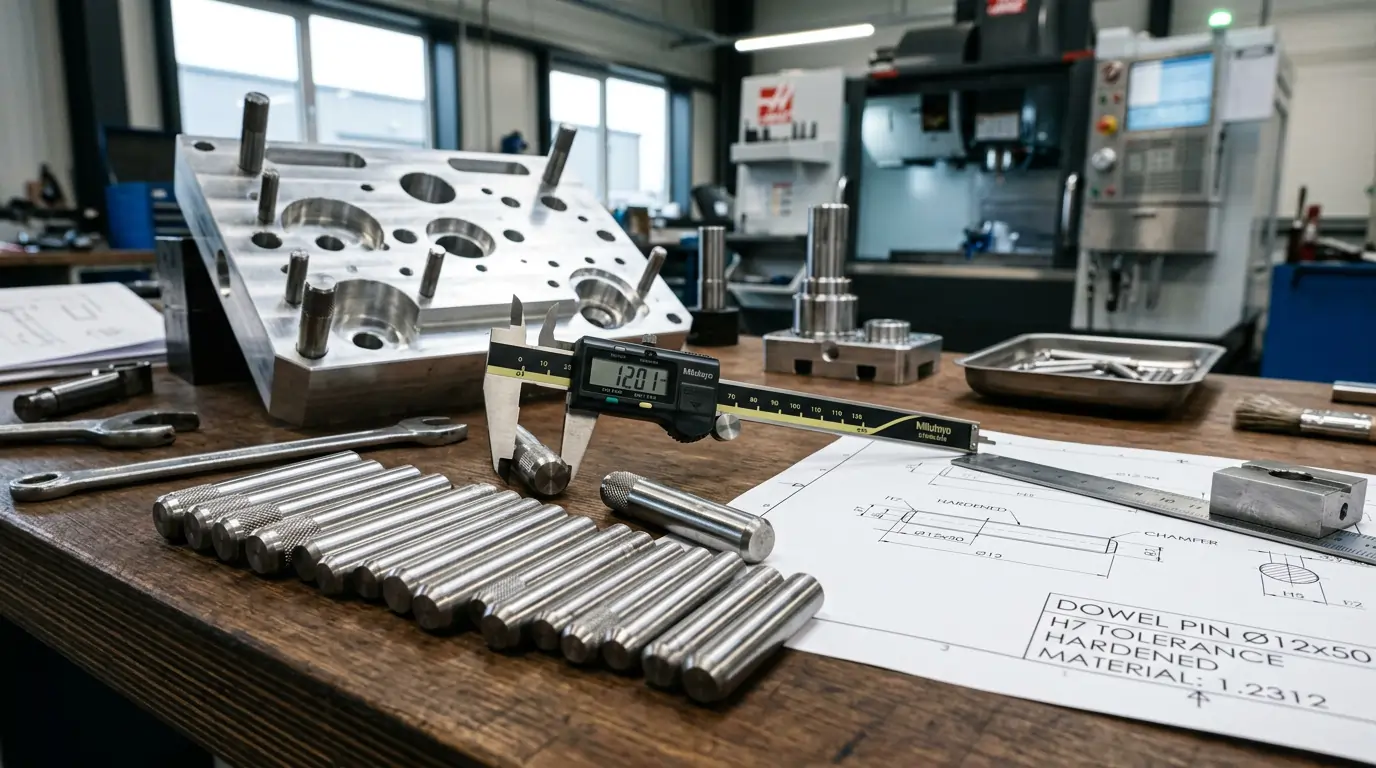
- What a Dowel Pin Actually Does
- Core Specs Worth Knowing Before You Order
- Industries That Depend on Them
- The Type You Pick Changes Everything
- What the Material Actually Does to Performance
- Specifying Correctly — What to Actually Ask For!
- Installing Them Right — Because Specification Is Half the Job
- About Anello Fasteners
- Conclusion
Spend enough time on a shop floor and you'll hear the same story from different engineers. The line was running fine, scrap rates looked normal, and then something shifted. Not dramatically — just enough. Bores stopped seating right, housings drifted off-spec, rework piled up. After hours of chasing the problem, somebody finally checked the alignment fixtures. The Dowel Pins were worn. Not broken. Worn. A difference of 0.02 mm that nobody had bothered to measure.
That's usually how people figure out how much these things actually matter. Custom Dowel Pins aren't glamorous. They don't show up in marketing brochures. But they're the reason a mould half seats identically every cycle, why an engine block bore lands where the drawing says it should, why a jig plate doesn't drift after three hundred setups. Get them right and nobody notices. Get them wrong and everyone does.
What a Dowel Pin Actually Does
A dowel pin locates. That's the job. It drops into a precision-reamed hole in one component and a matching hole in another, holding both in a fixed spatial relationship no matter how many times the assembly comes apart and goes back together. A bolt clamps — it doesn't position. The distinction sounds minor until you've tried to hold sub-0.05 mm positional accuracy across a thousand cycles using bolts alone.
Fit classification is where Dowel Pins sizes start to really matter:
- Press-fit (ISO m6) — goes in once and stays put
- Slip-fit (h6 or h8) — pulls out and reinstalls without trashing the bore
- Wrong choice — a press-fit pin forced into a slip-fit application rattles under vibration and creates the exact positional error you were trying to prevent
Most standard dowel pin sizes chart references cover diameters from under 1 mm up to 50 mm, with the 4 mm dowel pin and 5 mm dowel pin sitting in the sweet spot for general industrial and electronics work.
Core Specs Worth Knowing Before You Order
A handful of numbers separate a pin that performs from one that quietly causes problems:
- Diameter tolerance class — m6 for permanent press-fit, h6 or h8 for slip-fit or reusable installs
- Surface hardness — typically 58–62 HRC on steel pins, case-hardened or through-hardened depending on shear load
- Surface finish — Ra 0.4–0.8 μm keeps press forces consistent across a production run
- Dowel Pins material — carbon steel, alloy steel, or stainless, each with different load capacity and corrosion behaviour
- End geometry — chamfered ends ease entry and protect bore edges; flat ends suit flush-mount work
- Length — custom lengths come up more often than people expect, since catalogue items rarely cover every tooling-plate requirement
Industries That Depend on Them
Here is the table of industry and their typical applications:
| Industry | Typical Application |
|---|---|
| Automotive | Engine block alignment, gearbox housings, brake caliper fixtures |
| Electronics & PCB | SMT fixture location, panel registration, connector housings |
| Aerospace | Structural panels, turbine assembly, precision fixtures |
| Medical Devices | Surgical instrument tooling, implant fixtures, clean-room assembly |
| Die & Mould | Mould half registration, ejector plates, insert alignment |
| General Fabrication | Weld fixtures, modular workholding, assembly jig plates |
The Type You Pick Changes Everything
There's a habit of treating alignment pins as interchangeable, ordering whatever's cheapest, and wondering later why the assembly behaves oddly. Pin type is a functional decision, not a catalogue preference:
- Steel dowels — the standard. Ground to tight tolerances, dependable in permanent alignment work, and the most widely stocked.
- Threaded dowel pin designs carry an internal thread so they pull out with a bolt instead of being driven from the blind end. A genuine lifesaver in maintenance-heavy environments.
- Tapered dowel pins self-align by geometry, drawing mating parts together as the taper seats. Useful where coarser tolerance is acceptable.
- Slotted spring pins — compress radially during installation. Handle vibration and slightly inconsistent bores without complaint.
- Stainless steel dowel pins (303/316) — non-negotiable in food, pharma, marine, and medical work. The price premium is nothing compared to a corrosion-seized fixture.
- Small dowel pins serve watch-making, optics, and PCB fixture plates where space is a real constraint, not a design preference.
What the Material Actually Does to Performance
Pick up any catalogue and the material section looks simple. Carbon steel, stainless steel, alloy. Maybe a hardness value. What it rarely explains is how the pin material interacts with the bore material — and that interaction is where a lot of field problems actually begin.
Take a hardened steel pin pressed into an aluminium housing. On paper, the fit looks fine. After fifty or a hundred cycles, the aluminium bore starts to bell out. The pin holds its dimension; the housing doesn't. The result is a gradually loosening fit that introduces misalignment in the exact spot where misalignment was the thing being prevented.
Dowel pin material properties and selection come down to matching the job:
- 1045 carbon steel or 52100 alloy steel — covers most industrial tooling work
- 316 stainless — wash stations, outdoor fixtures, humid plants, food and pharma lines
- Ceramic or titanium — extreme temperature cycling, but cost and lead time put these in the specialty bracket
The right material isn't the most expensive one. It's the one matched to the actual operating conditions.
Specifying Correctly — What to Actually Ask For!
Most procurement conversations start and end with diameter and length. Those are the obvious numbers. The conversations that avoid downstream problems cover a bit more:
- Surface treatment matters — black oxide gives marginal corrosion resistance but improves lubricity during press-fit installation. Zinc plating adds more protection. Passivation is standard on stainless.
- Cross-reference a standard dowel pin sizes chart before finalising bore specs, especially when components come from suppliers in different countries where nominal sizing can differ slightly.
- If disassembly is ever going to happen, specify a threaded dowel pin from day one — retrofitting thread access into a blind bore is an expensive regret.
- Check whether a dowel pin extractor is needed for servicing, and confirm pin length and thread support it before the order ships.
- For fixtures that see repeated installs, h8 slip-fit usually beats m6 press-fit — even if the initial assembly feels less rigid, the bore lasts longer.
Installing Them Right — Because Specification Is Half the Job
Knowing how to use dowel pins properly gets skipped surprisingly often. The assumption is that pressing a pin into a hole is self-explanatory. It mostly is — except when people drill instead of ream, or hammer instead of pressing, or ignore the galling tendency of stainless against steel.
A few rules worth following every time:
- Ream the bore, don't just drill it. A drilled hole is rarely round or smooth enough for a consistent press fit.
- Use an arbour press and apply force axially. Hammering introduces angular misalignment you won't catch until the mating part seats crooked.
- Lubricate stainless against steel. A light film of anti-seize or cutting oil is the difference between a clean install and a seized pin requiring aggressive extraction.
- Get the dowel pin extractor on the shelf before the pins go in — not in a panic six months later when a fixture needs servicing.
About Anello Fasteners
Anello is a trusted name among contractors and procurement professionals seeking high-quality fasteners and best-engineered components. Anello Fasteners Pvt Ltd, since 1968, has been delivering precisely for more than 55 years. With a comprehensive product range and a commitment to consistency, Anello provides solutions that hold up under real-world conditions — literally and figuratively. If you are looking for fasteners, circlips, dowel pins, nuts, washers, bolts and other products, we are perfect for you. Anello also provides high-quality CNC-machined components and screws to meet the diverse demands of modern construction and manufacturing.
Conclusion
The reason Dowel Pins use keeps coming up in troubleshooting is that they're easy to underspecify. They're small, they're cheap relative to what they align, and they don't fail dramatically. They degrade quietly until the tolerance stack collapses. Getting material, fit class, and type right from the start costs almost nothing extra and removes an entire category of problems that otherwise take weeks to diagnose.
Whether you're sourcing locally — searching "dowel pin near me" for a regional distributor — or working with established Dowel Pins manufacturers, Dowel Pins exporters, and Dowel Pins suppliers for bulk supply, the starting point is always the application. Talk to the manufacturer about bore material, cycle count, environment. The right pin isn't always the hardest, the most expensive, or the most commonly stocked. It's the one that performs without drama in the specific conditions your line runs in.
That's a specification conversation worth having before the order ships — not after the first batch of rejects lands on the floor.
Contact us for bulk pricing, custom specs, and fast delivery from trusted Dowel Pins manufacturers, Dowel Pins exporters, and Dowel Pins suppliers.
Dowel Pins are used for precise alignment and positioning of components in machinery, tooling, fixtures, moulds, and assemblies. They help maintain accurate positioning during repeated assembly and disassembly cycles.
Common Dowel Pins material options include carbon steel, alloy steel, stainless steel, titanium, and ceramic. The material selection depends on load requirements, corrosion exposure, and operating conditions.
Steel dowels offer high strength and wear resistance for industrial applications, while stainless steel dowel pins provide superior corrosion resistance for food processing, marine, medical, and pharmaceutical environments.
Standard Dowel Pins sizes generally range from below 1 mm up to 50 mm diameter. Popular sizes include the 4 mm dowel pin and 5 mm dowel pin for industrial tooling and electronics applications.
A threaded dowel pin includes an internal threaded hole that allows easy removal using a bolt or extractor. They are especially useful in blind-hole assemblies and maintenance-heavy applications.
