

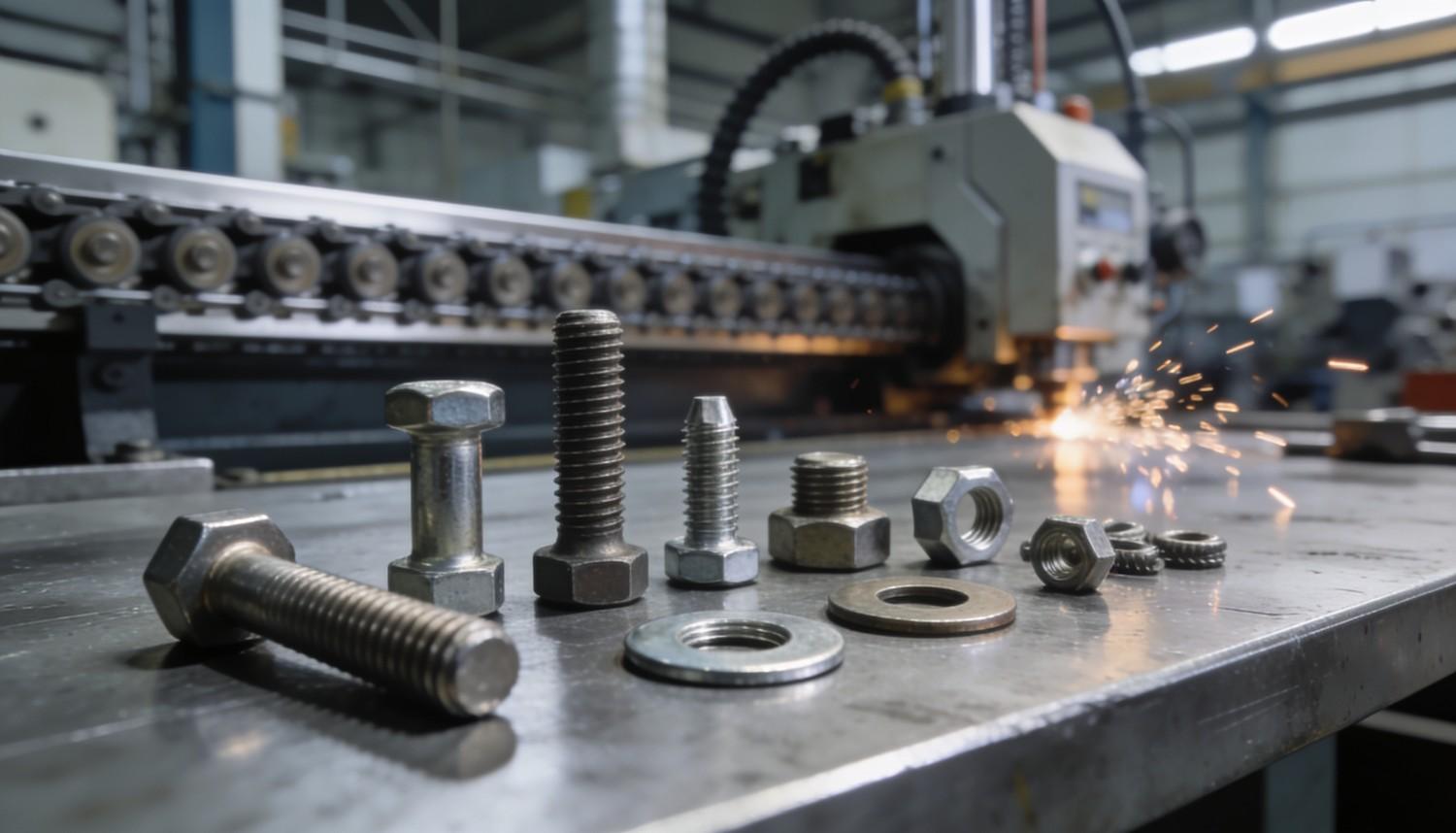
- How Fastener Quality Affects Machine Reliability
- What Exactly Is a Fastener?
- Why Quality Is the Actual Problem
- What to Actually Check Before You Buy
- Quality Comparison: Low-Grade vs High-Grade Fasteners
- Choosing the Right Supplier
- Where It Matters Most
- Buying Guide: Five Rules Worth Following
- Anello Fasteners
- Conclusion
What industrial buyers and maintenance teams must know before the next breakdown costs them a production shift.
Nobody thinks about the bolt until the machine stops.
That is honestly how most plants operate. Attention goes to motors, seals, bearings — and fasteners get ordered from whoever is cheapest that week. Until a flange joint opens under pressure. Until a conveyor frame cracks at the bolt hole. Until a gearbox cover loosens mid-shift and takes half the assembly with it.
The thing is — this is not bad luck. It is a sourcing decision playing out over time. A poor-quality bolt fastener does not fail the day it is installed. It fails three months in, when the cyclic load has fatigued the thread root and the clamping force is already gone.
This blog is for anyone who buys, specifies, or maintains industrial equipment. The goal is simple: understand what fastener quality actually means — and why cutting corners on it is one of the most expensive things a plant can do.
What Exactly Is a Fastener?
Any component that mechanically joins two or more parts. But fasteners screws bolts are not interchangeable — each type has a job, and using the wrong one is just as bad as using a low-grade one.
Common types in industrial settings:
- Hex bolts and studs — structural joints, flanges, frames
- Machine screws — precision assemblies, panels, enclosures
- Socket head cap screws — tight-tolerance mechanical housings
- Self-locking nuts — anywhere vibration is a constant problem
- Bullet fastener - self-drilling, pointed tip, applied in sheet metal or roofing tasks in which drilling ahead is inconvenient.
Even screw fasteners vary wildly by thread form, drive type, and material. Specifying the right one matters. Specifying a certified one matters more.
TRIVIA: India's fastener industry supplies over 20 sectors — from defence and railways to pharma and solar energy. A qualified Fasteners Manufacturer in India tests products across this entire range of operating stresses.
Why Quality Is the Actual Problem!
Here is what happens with low-grade fasteners — not in theory, in practice:
- Thread stripping under torque — soft material shears before reaching rated clamp load. The joint feels tight. It is not.
- Fatigue cracking — repeated load cycles initiate cracks at the thread root. No visible warning. Sudden failure.
- Inconsistent hardness — the bolt stretches unevenly. Clamping force distribution goes wrong. Joint loosens in weeks.
- Surface coating failure - poor quality/thin plating gives little protection from corrosion, and the first rusted fastener seized together will turn a 10-min maintenance operation into half a day one.
- Dimensional non-conformance - Bolts with minor variation in dimension slow down assembly at the line. Small, but expensive on volume.
Every single one of these failures has a sourcing decision behind it. And the fastener price saved upfront gets wiped out — usually several times over — in downtime and rework costs.
DID YOU KNOW? Industrial maintenance data consistently shows that fastener-related joint failures account for nearly 30% of unplanned machine stoppages in process industries — far higher than most plant managers estimate.
What to Actually Check Before You Buy
Whether sourcing locally or ordering fasteners online, these are the parameters that separate a reliable fastener from a risky one:
- Grade marking — ISO 8.8, 10.9, 12.9 for bolts. No marking usually means no certification.
- Material traceability — heat number, mill certificate, batch records. Needed for quality audits.
- Thread tolerance class — determines how well the fastener mates under load. Non-standard threads wear faster.
- Surface treatment — zinc plating, hot-dip galvanising, black oxide. Thin or uneven coating fails fast.
- Dimensional conformance — IS, DIN, or ISO standard compliance. Verified by inspection report, not just claimed on a catalogue.
Do not skip the trial batch step. Fit the fasteners in one complete assembly, run it through load cycles, inspect after. That 30-minute check saves months of headaches.
Quality Comparison: Low-Grade vs High-Grade Fasteners
| Parameter | Low-Grade | High-Grade |
|---|---|---|
| Material | Variable, unverified alloy | Certified mill-traceable raw stock |
| Thread Accuracy | Often outside tolerance | IS / DIN / ISO conforming |
| Surface Coating | Thin, uneven application | Uniform plating to specification |
| Load Performance | Below rated capacity | Meets or exceeds grade rating |
| Fatigue Life | Early crack initiation | Engineered for cyclic endurance |
| Maintenance Cost | High — frequent replacement | Low — extended service intervals |
Choosing the Right Supplier
Not every supplier calling itself a Leading Fasteners Supplier in India actually operates at that level. Here is what a genuinely capable supplier looks like:
- In-house testing — tensile, hardness, salt spray at minimum. Not outsourced to a lab three days away.
- Full product range — hex bolts, studs, nuts, washers, custom items. A single-source supplier reduces coordination overhead significantly.
- Standard compliance documentation — test certificates, dimensional inspection reports, not just spec sheets.
- Custom manufacturing capability — critical for OEM and replacement parts with non-standard dimensions.
The largest Fasteners Manufacturers in fasteners india run integrated facilities — wire drawing, cold forging, heat treatment, plating, and testing under one roof. That integration is what makes traceability possible and quality consistent.
For reliable quality and consistent performance, Anello Fasteners is the perfect fit for your fastening needs.
Where It Matters Most
These are the sectors where fastener quality failure costs the most:
- Heavy engineering — gearbox housings, press frames, crane structures. High load, high vibration, no tolerance for joint movement.
- Oil and gas — pressure vessel flanges, wellhead components. A joint failure here is a safety incident, not just a downtime event.
- Power generation — turbine casings, transformer mounting structures. Thermal cycling stresses fasteners differently from static loads.
- Automotive manufacturing — engine block assemblies, chassis brackets. Volume and precision both matter.
- Pharma and food processing — stainless steel grade fasteners required for hygiene compliance. Wrong material grade fails audits.
Buying Guide: Five Rules Worth Following
- Ask for a grade-wise price breakdown — not just unit rate. A bolt without a grade marking is a liability, not a saving.
- When comparing fastener price across suppliers, factor in coating type, certification, and MOQ together — not price alone.
- For critical joints, specify the fastener fully — material, grade, thread class, coating, standard. Do not leave it open to interpretation.
- If ordering fasteners online, download the technical datasheet. If there is no datasheet, that tells you something.
- Audit your fastener failure history. If the same joint is being redone every few months, the fastener spec — not operator error — is probably the issue.
Anello Fasteners
Anello is a trusted name among contractors and procurement professionals seeking high-quality fasteners and best-engineered components. Anello Fasteners Pvt Ltd, since 1968, has been delivering precisely for more than 55 years. With a comprehensive product range and a commitment to consistency, Anello provides solutions that hold up under real-world conditions — literally and figuratively. If you are looking for fasteners, circlips, dowel pins, nuts, washers, bolts and other products, we are perfect for you. Anello also provides high-quality CNC-machined components and screws to meet the diverse demands of modern construction and manufacturing.
Conclusion
Machine reliability does not start with the motor or the seal. It starts at the joint — and that means it starts with the bolt fastener, the nut, the screw fastener. These components are small. The consequences of getting them wrong are not.
Sourcing quality fasteners screws bolts from a verified Fasteners Manufacturer in India is not just about compliance. It is about building equipment that runs the way it is supposed to — shift after shift, without the unplanned stops that eat into margins and morale.
The next time a joint is being specified or a supplier is being evaluated — look past the unit price. What the fastener actually costs is what it costs when it fails.
| Partner With Anello Fasteners Get precision-engineered fasteners india built to certified standards — visit www.anellofasteners.com or reach out directly to discuss your requirements. |
Fasteners hold critical components together. When they loosen, crack, or fail, machines can suffer misalignment, vibration issues, unexpected downtime, and costly repairs.
Look for grade markings, material certifications, dimensional accuracy, corrosion-resistant coatings, and compliance with recognized standards such as IS, DIN, or ISO.
Yes. Quality fasteners reduce maintenance frequency, prevent unexpected failures, minimize downtime, and often lower total operating costs over the equipment's lifespan.
Heavy engineering, oil and gas, power generation, automotive manufacturing, construction, and food processing industries all rely on durable, high-performance fasteners.
Yes, provided the supplier offers technical datasheets, certifications, material traceability, and clear product specifications that match your application requirements.
Inspection frequency depends on operating conditions. Fasteners in high-vibration, high-load, or corrosive environments should be checked regularly during scheduled maintenance.
