

- What Is a Nut?
- Why Does It Matter?
- Types of Nuts You'll Actually Run Into
- Features Worth Checking Before You Buy
- Product Overview
- Benefits
- Where These Actually Get Used
- Comparison Table
- Expert Tips Before You Order
- Anello Fasteners
- Wrapping Up
A practical guide to nut fasteners — the variants, the fit, and why the right choice matters on a job site.
Small. Threaded. Easy to overlook. That's basically the story of every nut sitting in a bin on a factory floor. Pair one with a bolt and you've got one of the oldest joining tricks in engineering — still going strong because nothing simpler does the job as well. Not all of them are built the same, though. Pick the wrong variant and a joint that should've lasted years starts working loose in months. This piece covers what these fasteners are, the types of nuts you'll run into most, and where each earns its place.
What Is a Nut?
At its core, a nut is a fastener with a threaded hole, made to mate with a bolt or screw and clamp parts together. Tighten it and friction — between the threads, and between the fastener's face and whatever surface it sits on — locks the joint in place. It resists vibration. It resists rotation. It won't pull apart under normal load. Together, nut and bolt fasteners give you something welding can't: a joint you can open back up when parts need servicing. Doesn't matter if it's a bracket on a kitchen appliance or a beam holding up a structure — same principle, different scale.
Why Does It Matter?
Here's the thing — a joint is only as strong as its weakest fastener. Get the selection wrong and you're not just risking a rattle or a squeak. Panels loosen. Machinery drifts out of alignment. In bad cases, you get outright structural failure.
- Load distribution — spreads clamping force evenly so the base material doesn't take all the stress
- Keeps vibration in check, which matters a lot in equipment that runs around the clock
- Reusability — open the joint, service it, close it back up, no damage done
- Works across an enormous range of bolt sizes and thread pitches, so it's genuinely standardised
- Safety — a properly torqued fastener is often the one thing standing between "fine" and "failure"
Types of Nuts You'll Actually Run Into
Knowing the common industrial nuts out there helps you match fastener to job instead of guessing. Here's what shows up most on factory floors:
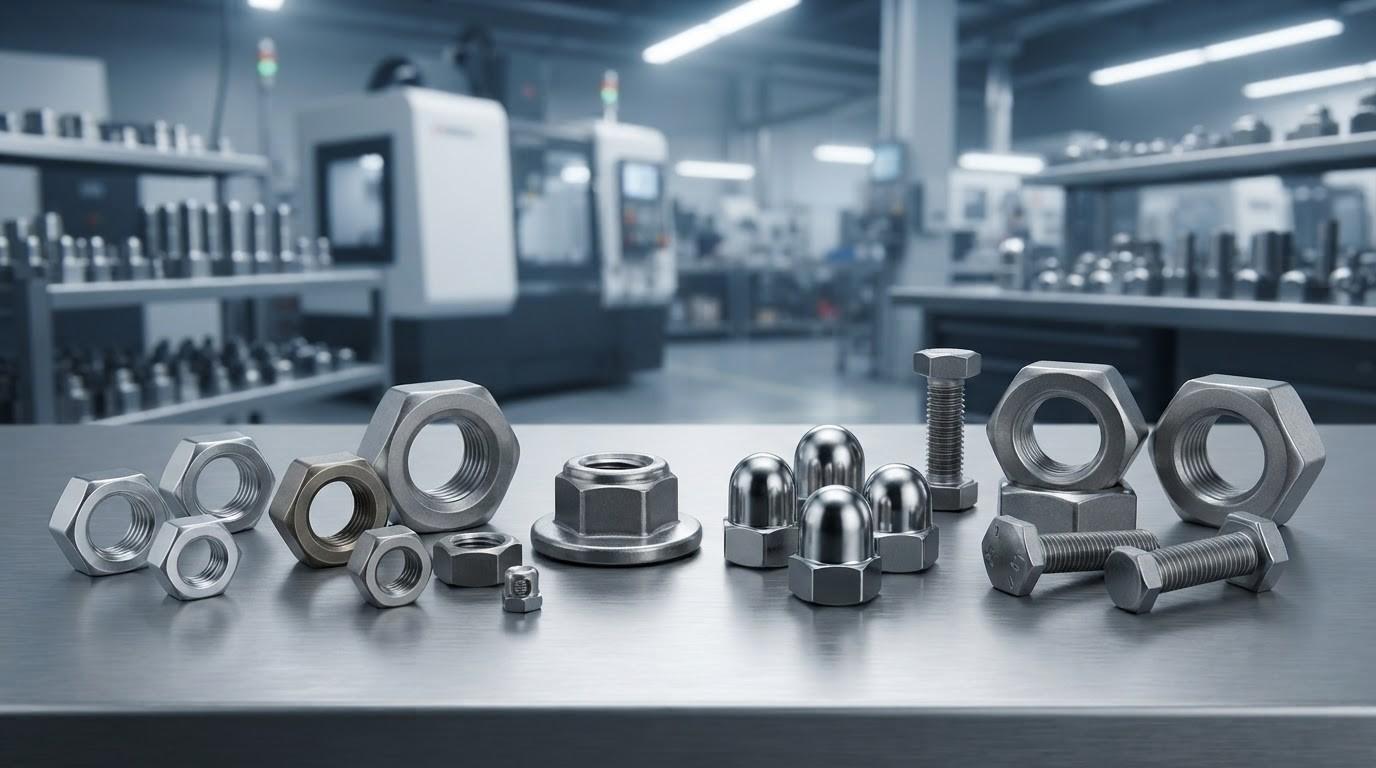
- Hexagonal nuts — six sides, easy wrench access even in cramped spots. The default choice for a reason.
- Square nuts aren't as common these days but they still show up in wood assemblies and older machinery frames, mostly because the flat sides grip harder and resist rounding under torque
- Capped on top, thread hidden underneath — these are usually called dome nuts, and they're picked for a clean finish as much as for keeping moisture off the exposed thread
- Flange nuts with serration — a built-in washer face with teeth that bite into the mating surface. Skips the need for a separate lock washer entirely.
- Wherever moisture, chemicals, or outdoor exposure would cause rust, you'll find stainless steel nuts doing the job instead
- Heavy-duty hex nuts — thicker, tougher, built for high-torque and high-vibration work like structural frames and heavy machinery
Mix these up on a project and the whole assembly quietly pays for it later.
Trivia: Six sides on a hex nut isn't random. It's the sweet spot — enough flat surface for a wrench to grip firmly, but still narrow enough to fit into gaps a four-sided fastener never could.
Features Worth Checking Before You Buy
Here are the detailed features worth checking before you buy a nut:
- Thread accuracy — matched to ISO or metric bolt standards, no exceptions
- Material grade suited to the load and the environment (mild steel, alloy, or stainless steel nuts for anything exposed)
- Corrosion resistance, especially for outdoor or washdown conditions
- Hardness and tensile strength that stay consistent batch to batch
- Finish — plain, zinc-plated, or passivated, depending on where it's going
- Traceability. If a supplier can't tell you where a batch came from, that's a red flag.
Did You Know? A properly torqued nut-and-bolt joint can actually outperform a welded one under vibration. Clamping force increases resistance as load goes up, which welded joints simply don't do.
Product Overview
Sourcing at scale isn't like grabbing a handful of fasteners off a hardware shelf. Procurement teams run spec checks and sample testing first — one bad lot can quietly wreck an entire production run.
Industrial nut manufacturers generally run a catalogue spanning several head styles, thread standards, and material grades. The better nut manufacturers in India keep cold forging, heat treatment, and thread rolling in-house, which keeps dimensional accuracy tight across large runs. Buyers ordering in bulk want certified batches — nobody wants to find mid-assembly that a lot doesn't match spec. SS nut bolts need tighter finishing control than most, since surface flaws show up as corrosion problems years down the road, not immediately.
Benefits
Understand the major benefits of nut before buying it:
- Faster to assemble and disassemble than anything permanent
- Available in more sizes, threads, and materials than most people realise
- Cheaper than specialised fastening systems, in most cases
- Easy to inspect during maintenance — pull it, check it, put it back
- Plays well with automated, high-speed assembly lines
- Lasts a long time, provided it's matched to the right bolt grade
Where These Actually Get Used
Here are the applications of nuts for better understanding:
- Automotive assembly — engine mounts, chassis joints, suspension parts
- Construction — structural steel framing, railings, scaffolding
- Machinery — motor housings, conveyor systems, pump assemblies
- Electrical panels — cable trays, enclosure fixing
- Railways — track fittings, rolling stock
- Agriculture equipment — implement frames and attachment points
- Solar mounting structures, where stainless steel nuts get specified more often than not because of weather exposure
Fact: Flange nuts with serration get specified heavily in vibration-prone assemblies for one simple reason — the serrated face cuts back-off without needing a separate washer. Less material, less assembly time.
Comparison Table
Here are the comparison table of various nuts for in-depth understanding:
| Nut Type | Distinguishing Feature | Best Suited For |
|---|---|---|
| Hexagonal nuts | Six-sided, wrench-friendly | General-purpose fastening |
| Square nuts | Four flat sides, strong grip | Wood assemblies, older machinery |
| Dome nuts | Capped top, sealed thread | Decorative or exposed safety ends |
| Flange nuts with serration | Built-in serrated washer face | Vibration-prone assemblies |
| Stainless steel nuts | Corrosion-resistant alloy | Outdoor, marine, chemical exposure |
| Heavy-duty hex nuts | Thicker body, higher torque rating | Structural and high-load joints |
Expert Tips Before You Order
- Match thread pitch exactly. Even a slight mismatch strips under torque.
- Pick material grade based on the environment it'll actually sit in, not just cost
- Fastener hardness class and bolt grade need to match — always
- Ask for test certificates, especially on stainless steel nuts and SS nut bolts
- Check finish consistency across the whole order, not just a sample piece
- Stick with established industrial nut manufacturers who keep traceable production records
- One design doesn't fit every job — vibration, load, exposure all change what's right
Anello Fasteners
Anello is a trusted name among contractors and procurement professionals seeking high-quality fasteners and best-engineered components. Anello Fasteners Pvt Ltd, since 1968, has been delivering precisely for more than 55 years. With a comprehensive product range and a commitment to consistency, Anello provides solutions that hold up under real-world conditions — literally and figuratively. If you are looking for fasteners, circlips, dowel pins, nuts, washers, bolts and other products, we are perfect for you. Anello also provides high-quality CNC-machined components and screws to meet the diverse demands of modern construction and manufacturing.
Wrapping Up
Small parts, big responsibility. That's really what this comes down to. Know the difference between hexagonal nuts, square nuts, dome nuts, and something more specialised like flange nuts with serration, and sourcing decisions get a lot easier. Whether it's a one-off prototype or a bulk order from trusted nut manufacturers in India, the fastener has to match the application. Get that right, and the joint outlasts everything around it.
| Need industrial nuts built to spec? Reach out to Anello Fasteners and get the best product suited to your project. |
Flange nuts with serration are usually the answer. That built-in serrated face bites into the mating surface and resists loosening on its own, so you skip the separate lock washer entirely. Heavy-duty hex nuts come close too, especially in structural or high-torque setups where things shake constantly.
Pretty much, yes — unless you enjoy replacing rusted fasteners every couple of years. Regular steel corrodes fast once moisture and weather get involved. Stainless steel nuts cost a bit more upfront, but they hold up through rain, humidity, and temperature swings without needing constant maintenance or early replacement.
Start with the load and vibration level, not the price tag. Heavy-duty hex nuts suit high-torque joints well. Match hardness class to the bolt grade, confirm the thread pitch lines up exactly, and don't skip corrosion resistance if the machine runs outdoors or near moisture.
Start with the load and vibration level, not the price tag. Heavy-duty hex nuts suit high-torque joints well. Match hardness class to the bolt grade, confirm the thread pitch lines up exactly, and do not skip corrosion resistance if the machine runs outdoors or near moisture.
They are not gone, just less common than hex nuts. Square nuts still turn up in wood assemblies and older machinery frames because the flat sides grip harder and resist rounding under torque. For most modern applications though, hexagonal nuts remain the more practical, widely available choice.
