

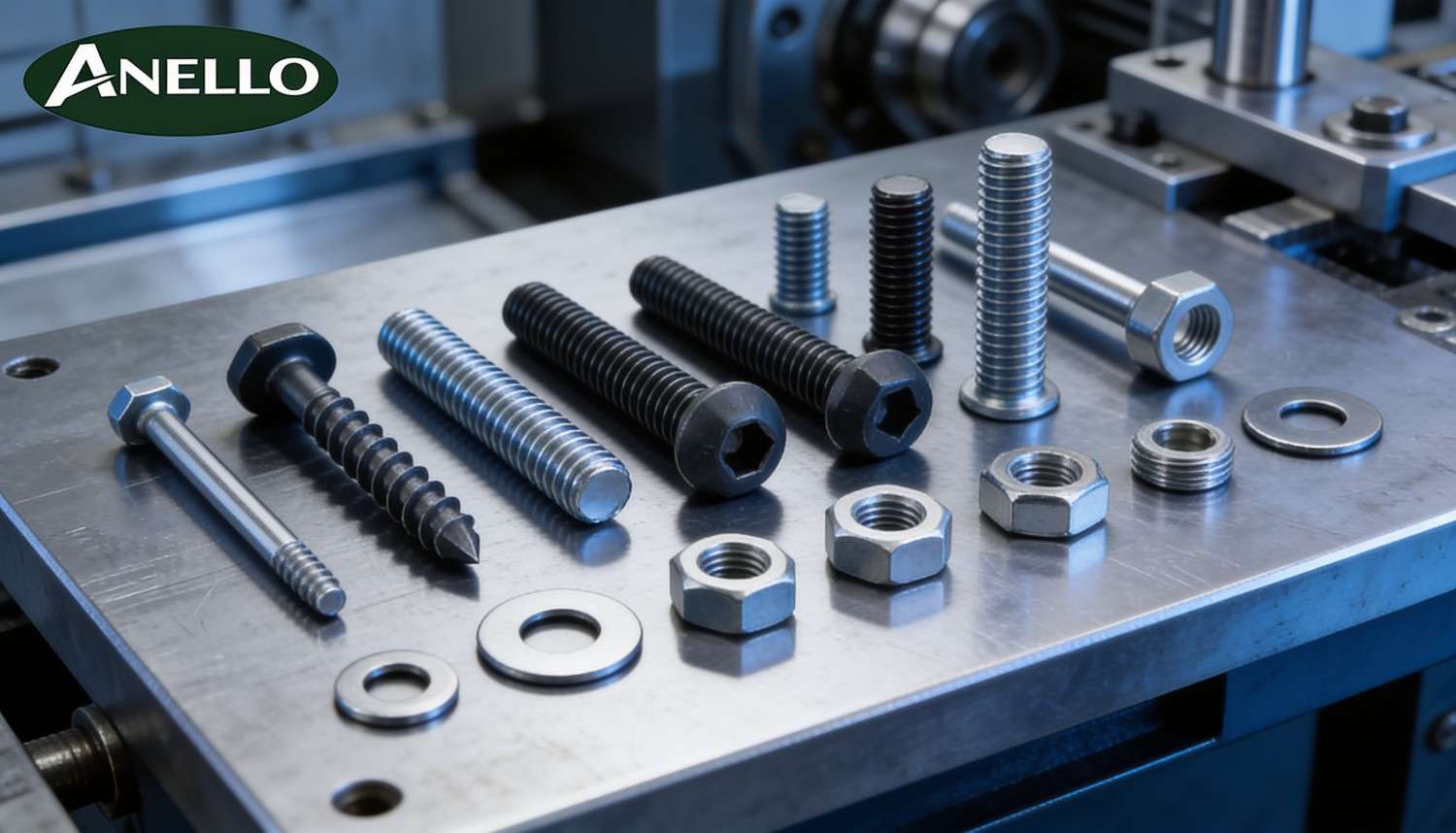
- What is a Screw?
- Why is it Important?
- Types of Screws
- Features to Look For
- Product Overview
- Benefits
- Applications and Use Cases
- Comparison Table
- Expert Tips and Buying Guide
- Anello Fasteners
- Conclusion
A practical buying guide to choosing the right fastener for stronger, safer industrial assemblies
Nobody gets excited about a screw. Fair enough. But walk through any factory floor and you'll see them everywhere, holding panels shut, gripping brackets, keeping motors bolted to their mounts. Skip on quality here and the cracks show up later, usually at the worst time.
Ask anyone who's run a production line for a while - they'll have a story about a batch of bad fasteners costing them a weekend they didn't plan on losing.
This guide is for anyone who actually has to order these things: plant managers, procurement folks, design engineers. We'll go through the types, what to check before buying, and where each one actually gets used on the ground.
What is a Screw?
A screw is a threaded fastener. It turns into material, or into a screw nut, and grips tight enough to resist being pulled back out. That's the whole job, really - hold things together under load, heat, and vibration without backing off.
Heads, drives, pitches - there's a lot of variation, and each combination suits a different job. That's also why “just grab any screw” rarely works out well on a serious production line.
Most of the time screws don't work alone. They're part of a bigger family - screws and bolts together - that forms the backbone of mechanical joining in construction, automotive work, and heavy machinery.
Why is it Important?
Get the fastener wrong and it shows up as downtime, eventually. Vibration loosens a bad batch over time. Corrosion eats at the wrong coating. A stripped thread can halt a whole assembly step until someone catches it.
It's not only a repair bill either - one bad connection point can hold up a shipment, or put someone working near moving machinery in real danger.
DID YOU KNOW: one loose fastener on rotating equipment can chew through neighbouring parts in hours, not weeks.
Types of Screws
Here's what most industrial buyers end up choosing between:
- Machine Screws - paired with a tapped hole or a screw nut, used where assembly needs to be precise and repeatable.
- Self-Tapping Screws - cut their own thread into sheet metal or plastic. No pre-tapped hole needed.
- Wood Screws - furniture, pallets, timber framing. Nothing fancy, just reliable.
- Socket Head Screws - small head, fits tight spaces, handles torque well.
- Heavy Duty Screws - for structural loads and outdoor exposure, where you can't cut corners on strength.
- Self-Drilling Screws - drill and fasten together, one motion. Roofing crews use these a lot.
Features to Look For
Before placing an order, run through this checklist:
- Material grade - carbon steel, stainless, or alloy. Pick it against load and exposure, not habit.
- Thread type - coarse for soft materials, fine where precision matters more.
- Head style - hex, socket, countersunk. Depends on tool access and how it needs to look once installed.
- Coating - zinc, black oxide, galvanising. Match it to the real environment, not the spec sheet.
- Fit with the mating screw nut or tapped part - honestly, this is where most returns come from.
Product Overview
Good Industrial Screws Manufacturers hold tight tolerances batch after batch. That's really the whole reason to buy from them instead of grabbing whatever's cheapest. Established Screws Manufacturers also hand over proper material certs, which saves a headache once an auditor comes asking for paperwork.
TRIVIA: the standardised thread we use now only became common during the industrial revolution - factories finally needed parts that fit each other, not just close enough.
Benefits
Buy the right fastener and the payoff shows up over time:
- Joints hold under vibration instead of slowly working loose.
- Sizing stays consistent across large orders - nobody's stuck sorting bad parts on the line.
- Coatings and material choice that actually stretch the service life.
- Fewer repeat purchases, which adds up to real savings over a year.
- Easier compliance on anything load-bearing or safety-critical.
Applications and Use Cases
Industrial Screw Applications show up almost everywhere once you start looking:
- Automotive lines - Machine Screws hold panels, brackets, engine parts, all of it.
- Construction and steel structures lean on Heavy Duty Screws for the load-bearing joints.
- Electronics enclosures need smaller screws, tighter fits, less room for error.
- Solar and renewable setups deal with outdoor exposure, so corrosion resistance matters more.
- Railways and material handling gear need fastening that's predictable, run after run.
Different industries, same demand really - hold steady under whatever stress that specific job throws at it.
Comparison Table
A general look at common screw types and where they're typically used - no sizes or pricing, just a quick reference.
| Screw Type | General Use | Common Material |
|---|---|---|
| Machine Screws | Securing machine parts and panels with a nut or tapped hole | Steel, stainless steel |
| Self-Tapping Screws | Creating their own thread in metal sheets or plastic | Hardened steel |
| Wood Screws | Joining wooden components in furniture and structures | Carbon steel, brass |
| Socket Head Screws | High-torque assembly in compact machine spaces | Alloy steel |
| Heavy Duty Screws | Load-bearing industrial and structural fastening | High-tensile steel |
Expert Tips and Buying Guide
A few things that actually help when hunting for the Best Screws for a job:
- Match thread pitch to the mating part. Don't just assume it'll fit.
- Ask for material test certificates on anything safety-critical - skip this at your own risk.
- Judge coatings against the real operating environment, the catalogue description won't tell you much.
- Build a relationship with reliable Screw Suppliers in India who can actually hold volume over time.
- Compare lead times and quality systems across a few Screw Distributors in India before locking into one contract.
FACT: fasteners make up a tiny slice of total assembly cost but cause a disproportionate share of mechanical failures when chosen carelessly.
Anello Fasteners
Anello is a trusted name among contractors and procurement professionals seeking high-quality fasteners and best-engineered components. Anello Fasteners Pvt Ltd, since 1968, has been delivering precisely for more than 55 years. With a comprehensive product range and a commitment to consistency, Anello provides solutions that hold up under real-world conditions — literally and figuratively. If you are looking for fasteners, circlips, dowel pins, nuts, washers, bolts and other products, we are perfect for you. Anello also provides high-quality CNC-machined components and screws to meet the diverse demands of modern construction and manufacturing.
Conclusion
Screws are small. Their impact isn't. Get the type, material, and fit right and you avoid most of the downtime that traces back to fastening failures in the first place. It's one of the cheapest insurance policies a production line has.
Work with manufacturers and suppliers who actually understand the engineering side, not just the order form, and the fastening holds up the way it's supposed to - batch after batch.
Get in Touch
Need dependable industrial fasteners for your next project? Get in touch with Anello Fasteners and source the right screws and bolts for your exact specification.
A machine screw needs a pre-tapped hole or a nut to bite into — it's built for precision, repeatable assembly. A self-tapping screw cuts its own thread as you drive it in, so there's no tapping step beforehand. Machine screws suit machinery and panels; self-tapping screws work better on sheet metal or plastic where speed matters more than perfect fit.
If the joint's carrying real structural load, sitting outdoors, or facing constant vibration, go heavy duty. Standard screws handle lighter indoor assembly fine, but they'll fatigue or loosen under stress they weren't built for. When in doubt, check the application's load and environment first — that decides it, not the price tag.
It matters more than people think. Zinc plating, black oxide, galvanising — each handles moisture and corrosion differently. Pick the wrong one for the environment and you'll see rust or weakening well before the screw's actual lifespan runs out. Match the coating to where it's actually going, not just what looks fine on the shelf.
Not really fit depends on thread pitch and diameter, so a nut sized for one screw will not grip another reliably. Mismatched pairs are actually a common cause of returns and loose joints on assembly lines. Always confirm the nut and screw are made to match before ordering in bulk, especially for safety critical work.
Tolerances vary supplier to supplier, even when the spec sheet looks identical. Some manufacturers hold tighter quality control than others, which shows up as inconsistent thread fit or strength across batches. That is why sticking with one reliable, certified source matters more for industrial buyers than chasing the lowest price each time.
Assuming close enough works. Buyers often skip checking thread pitch, material grade, or coating against the actual application, then deal with failures later. It is a small upfront check that saves a lot of downtime. Spend the extra few minutes confirming specs before placing a bulk order it is worth it every time.
